


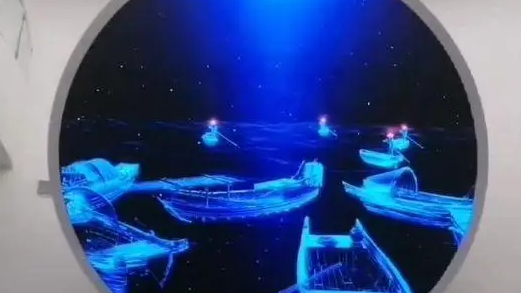
Are landmark screens mediocre? A breakdown of the 3D motion-sensing interactive solution.City landmark LED screens often become mere "visual backdrops" due to their single playback mode. However, the 3D motion-sensing interactive solution uses spatial perception and real-time rendering technology to transform giant screens into interactive urban digital sculptures. This solution, centered around millimeter-level motion capture, translates pedestrian gestures into visual feedback on the screen, reshaping the interactive logic of landmark screens.A three-layer breakdown of the hardware architecture.The underlying perception layer utilizes a hybrid sensing solution: LiDAR (scanning range 0-50 meters) builds a spatial point cloud model, a TOF depth camera (accuracy ±2mm) captures human skeletal nodes, and a binocular vision camera (resolution 1280×720) enables dynamic object recognition. In one commercial plaza, 32 distributed sensors formed into a circular array can simultaneously track 2
In virtual shooting scenes, if the parameters of the LED display screen as the background do not match, problems such as screen tearing and reflection goofs often occur. Professional parameter configuration is the core of eliminating goofs. The following is a list of LED parameters and setting logic for virtual shooting.Pixel pitch and resolution: need to be accurately matched according to the shooting distance. When the camera is 3-5 meters away from the screen, P1.2-P1.5 micro-pitch modules are recommended, with a pixel density of more than 40,000 dots/㎡, which can avoid the appearance of pixel lattices in close-up shots. The resolution supports at least 4K (3840×2160), and high-end movie-level scenes require 8K (7680×4320) to ensure that the pixel accuracy of the virtual scene is consistent with that of the real shot.Refresh rate and shutter synchronization: The camera shutter speed is usually set to 1/50-1/125 seconds, the LED screen refresh rate must be ≥240Hz, and progressive sca
In today's era of information explosion, LED display screens, as an important carrier of information dissemination, are widely used in many scenes such as shopping malls, transportation hubs, stage performances, etc. However, the problem of color distortion often troubles users, causing many complaints, greatly affecting the information transmission effect and user experience.The reasons for color distortion of LED display screens are complex and diverse. From the hardware level, there are subtle differences in the luminous characteristics of different batches of LED lamp beads, such as the inconsistency of the chip's luminous wavelength, brightness and angle, which will cause the same picture to have uneven colors. Moreover, during the installation process, if the gap between the modules is too large, the angle is deviated, or the local temperature difference is caused by uneven heat dissipation, it will also have a negative impact on the color performance. From the perspective of par
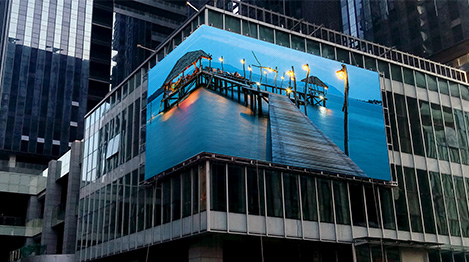
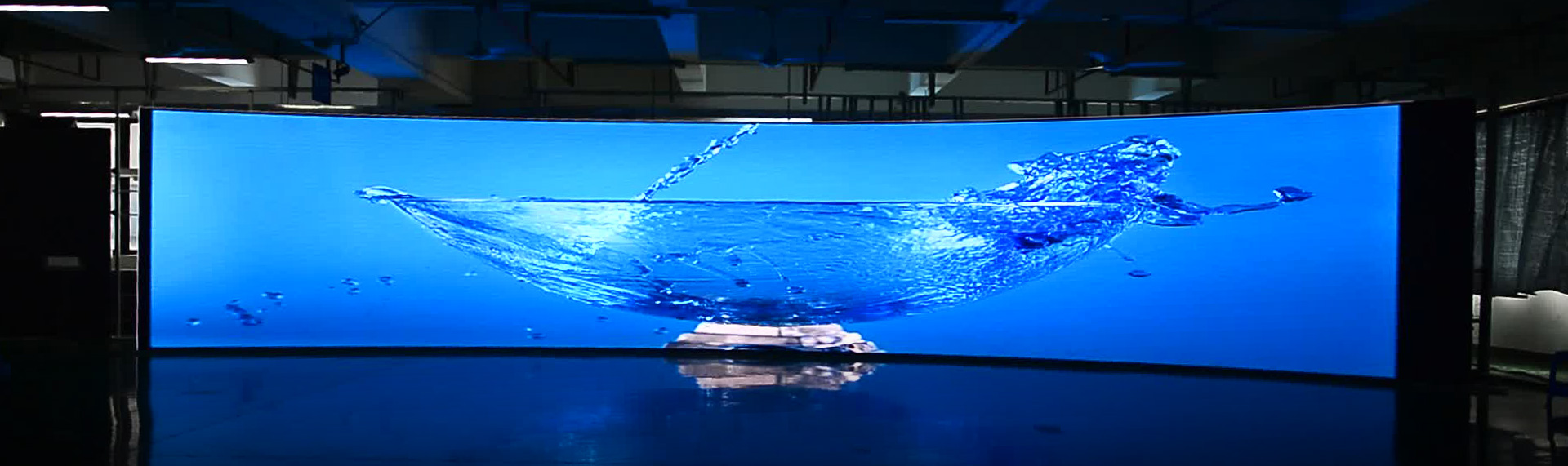
When LED display screens are applied to special-shaped buildings such as curved curtain walls and spherical domes, traditional flat screens frequently have problems such as splicing gaps and pixel distortion due to insufficient bending precision. The bending precision control technology of curved screens provides a "millimeter-level adaptation solution" for special-shaped building displays through full-process parametric management. This technology is based on finite element analysis and combines the material properties of flexible substrates to control the bending error of the display screen within ±0.3mm, achieving precise fitting between the building surface and the display surface.Preliminary surveys require the use of three-dimensional laser scanning to collect point cloud data of the building surface, generate a curved surface model with an accuracy of 0.1mm, and then use CAD software to convert the model into a display screen bending path diagram, marking the curvature radius an
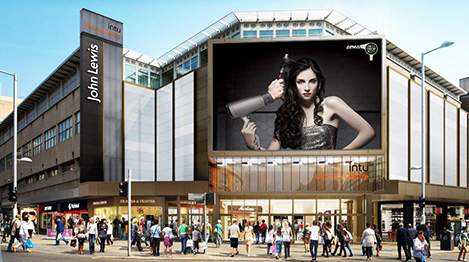
In bustling commercial districts, outdoor LED screens are lined up, playing all kinds of advertisements. However, many businesses are troubled by insufficient ad click-through rates and cannot effectively attract pedestrians' attention. At this time, the dynamic particle special effects library brings new opportunities.Particle special effects can quickly catch people's attention through unique visual effects. The dynamic particle special effects library contains a variety of styles of particle effects, such as particle spraying, drifting, convergence, explosion, etc. When these special effects are applied to LED display ads, they can significantly increase the attractiveness of ads.Take beauty ads as an example. In the past, products displayed statically or in regular dynamics had mediocre click-through rates. But when particle special effects are used, bright particles are sprayed out around cosmetics, or at the moment of product display, particles bloom like fireworks, and the charm
When LED display screens are used in emergency command, public warning and other scenarios, the second-level response of emergency notifications is crucial, and the 10-second pop-up protocol optimizes the underlying communication protocol to build a "green channel" for rapid information triggering and display. This protocol is based on the UDP/IP communication architecture. Through data priority marking and interruption mechanism, emergency instructions can break through the regular playback queue and directly trigger the pop-up display of the display screen, solving the notification delay problem from the protocol level.Before configuration, three environmental preparations need to be completed: confirm that the LED display control system supports UDP protocol communication, check whether the main control device has enabled port mapping (default port number 9999); install the dedicated protocol configuration software on the management computer, and ensure that it is in the same LAN as
When commercial complexes, transportation hubs and other scenes use multiple LED screens for linkage display, problems such as signal asynchrony and content confusion occur frequently. The cascade control system builds a "digital nerve center" for multi-screen collaboration through topological architecture design and protocol adaptation. The system is based on the master-slave control mode. It cascades multiple controllers into a tree network through network cables or optical fibers, so that the scattered LED screens form a unified display unit, solving the root cause of information confusion from the hardware bottom.Before deployment, the "three elements" planning must be completed: draw a physical topology diagram according to the layout of the display screen to determine the location of the main controller and the signal transmission path; calculate the total number of pixels to ensure that the bandwidth of the main control device meets the 4K/8K signal transmission requirements; cl
In rainy and foggy weather, water droplets and fog are easily attached to the surface of LED display screens, forming a "hazy filter" that causes the screen to be gray. The nano-hydrophobic coating uses molecular-level protection technology to create an "invisible shield" for the display screen that is water-resistant and fog-resistant. The coating uses silica nanoparticles as the core material. After construction, a rough microstructure with a diameter of only 50-100nm is formed on the surface of the screen, like countless microscopic "lotus leaf protrusions". The surface tension is used to make water droplets gather into a sphere and roll down, while reducing the area of fog adhesion, solving the problem of screen graying from a physical level.Before construction, three basic preparations need to be completed: wipe the surface of the LED display screen with a dust-free cloth dipped in a special cleaner to remove oil and dust; ensure that the construction environment temperature is 15
When people look at LED displays from a distance in squares and streets, they often find it difficult to identify information due to blurred text edges and sticky strokes. This is essentially a visual defect caused by the mismatch between pixel density and viewing distance. Pixel density (PPI) is like the "visual resolution gene" of LED displays, which directly determines the fineness of the picture. The pixel density calculator is a "digital strategist" that uses scientific algorithms to enable LED displays to achieve clear display in long-distance scenes. This tool uses the human eye's visual threshold as a benchmark to convert parameters such as the display's physical size, pixel pitch, and viewing distance into a visual data model, just like customizing a "vision correction solution" for LED screens.Taking a common outdoor advertising screen as an example, when the audience is watching from 50 meters away, the pixel density of an ordinary P10 model LED display (pixel pitch 10mm) ca











 CN
CN
 Home >


